



First Cases of Avian Influenza Detected in California's Northern Elephant Seals
Cases at Año Nuevo State Park Mark State’s First Detection of the Disease in a Marine Mammal
Seven weaned elephant seal pups in California’s Año Nuevo State Park tested positive for highly pathogenic avian influenza (HPAI) H5N1, the U.S. Department of Agriculture’s National Veterinary Services Laboratory confirmed Tuesday evening.
The outbreak marks the first cases of HPAI H5N1 in marine mammals in California and the first detection in northern elephant seals. The disease decimated populations of a related species, southern elephant seals, in Argentina in 2023.
“This is exceptionally rapid detection of an outbreak in free-ranging marine mammals,” said Professor Christine Johnson, director of the Institute for Pandemic Insights at the UC Davis’ Weill School of Veterinary Medicine. “We have most likely identified the very first cases here because of coordinated teams that have been on high alert with active surveillance for this disease for some time.”
Scientists at UC Santa Cruz and UC Davis increased disease surveillance of this population in recent years due to concerns about avian influenza’s spread throughout North and South America.
“Given the catastrophic impacts observed in related species, we were concerned about the possibility of the virus infecting northern elephant seals for the first time, so we ramped up monitoring to detect any early signs of abnormalities,” said Roxanne Beltran, a professor in Ecology and Evolutionary Biology at UC Santa Cruz. Beltran’s lab leads UC Santa Cruz’s northern elephant seal research program at Año Nuevo.
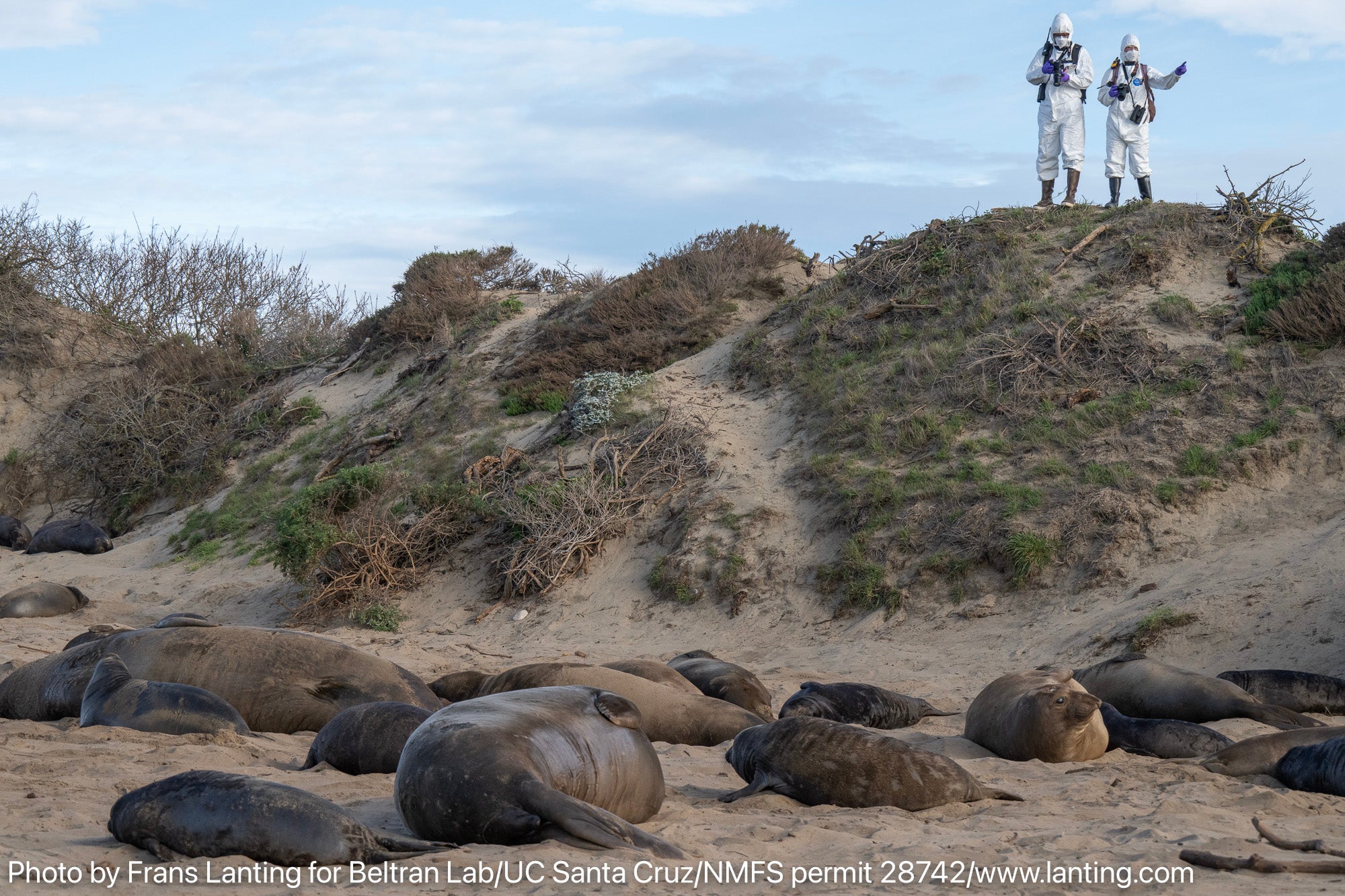
Researchers wearing personal protective gear overlook the seal colony at California's Año Nuevo Reserve on Feb. 24, 2026. They are collecting observational data to continue a long-term dataset, including information about individually flipper-tagged northern elephant seals and their symptoms.
On Feb. 19 and 20, Beltran’s team noticed seals at Año Nuevo Reserve with abnormal respiratory and neurological signs, including weakness and tremors. They collected samples from sick and dead elephant seals and took them to UC Davis for testing at the California Animal Health and Food Safety Laboratory System. Initial screening revealed the samples were positive for avian influenza, which the USDA’s NVSL lab now confirms is HPAI H5N1.