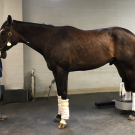
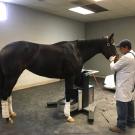
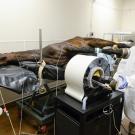
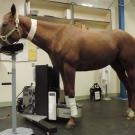
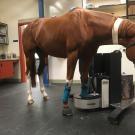
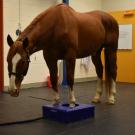
One year ago, on December 12, 2019, Santa Anita Park installed the world’s first MILE-PET device, a positron emission tomography (PET) scanner specifically designed to image standing racehorses. This installation, one of several measures to reduce breakdowns at the racetrack, received a lot of attention at a time when Santa Anita was just coming out of a challenging racing season, with a cluster of horse fatalities early in the year.
The equine Positron Emission Tomography (PET) scanner pioneered by the UC Davis School of Veterinary Medicine, in collaboration with LONGMILE Veterinary Imaging, is now in heavy use at Santa Anita Park in Southern California. In just over six months since the installation in December 2019, with the financial support from the Stronach Group, more than 100 scans have been performed with the “MILEPET” (Molecular Imaging of Limbs in Equids), the PET scanner specifically designed to acquire images on horses without the need to lay them down.
Dr. Mathieu Spriet, an associate professor in the Department of Surgical and Radiological Sciences, recently passed boarding examinations to become a founding member of the American College of Veterinary Radiology’s (ACVR) new subspecialty of Equine Diagnostic Imaging.
The UC Davis School of Veterinary Medicine, in collaboration with LONGMILE Veterinary Imaging, has completed the first phase of the validation of the MILE-PET, the first positron emission tomography (PET) scanner specifically designed to image the limbs of standing horses, using light sedation, eliminating the need for anesthesia.
With a goal of bringing imaging technology directly to the racetrack, UC Davis veterinary researchers are helping the horse racing industry to better detect and understand injuries, and ultimately prevent future catastrophic breakdowns. The technology being utilized by the UC Davis School of Veterinary Medicine is positron imaging tomography (PET), and its development continues to make major progress toward early detection of racehorse injuries.
A leg injury can quickly spell the end of a racehorse’s career. For one racehorse in California, though, her injury offered an opportunity for innovative imaging and stem cell treatments, and ultimately a trip back to the winner’s circle. In November 2016, Irish Streetsinger, a 3-year-old female Thoroughbred, was showing some lameness while training and was brought to the UC Davis veterinary hospital for evaluation. Owner Bob McCabe was willing to do whatever it took to get Irish Streetsinger healthy again.
A significant advance in veterinary research is coming to the racetrack in the form of a standing equine PET scanner. The machine will soon be available at Santa Anita Park, marking a major milestone in the battle against racetrack injuries.
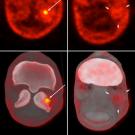
Positron emission tomography (PET) scanning technology has been proving its worth in assessing issues in the horse’s foot and the suspensory ligament.
The technology has been pioneered by UC Davis, which became the first veterinary hospital in the world to install an equine PET scanner in 2016. Since then, there have been more than 85 equine PET studies.
Positron emission tomography (PET) scanning technology has now been in place at the UC Davis veterinary hospital for two years. In 2016, UC Davis became the first veterinary hospital in the world to implement an equine PET scanner, and has since added a small animal scanner in 2018.