News

Crucial Resources on Devastating New World Screwworm Parasite


Earlier this fall, the New World screwworm – the flesh-burrowing larva of a blowfly (Cochliomyia hominivorax) – was detected in cattle in Mexico just 70 miles from the U.S. border. Most recently, in late November, another case was confirmed in Nuevo León, a state of Mexico adjacent to Texas.

2025 Year in Review: Advancing Veterinary Medicine Without Limits

As 2025 comes to a close, we reflect with pride on a year defined by momentum, innovation, and meaningful impact. From transformative facilities and groundbreaking research to global engagement and student success, the UC Davis School of Veterinary Medicine continued to advance animal, human, and planetary health in powerful ways. Below are just a few highlights from an extraordinary year.

In Memoriam of Stephen Reinl


The school is mourning the passing on November 25 of Stephen Reinl of the California Animal Health and Food Safety (CAHFS) Davis lab. 

Steve graduated from UC Davis with a BS in Genetics, worked for 13 years in private industry designing and producing novel therapeutic proteins and antigens for human diseases, then spent several years as a stay-at-home dad with his three young children before joining CAHFS in 2012 as an SRA2 in Davis-Bacteriology.  

Dog’s Long Journey to Happy Home Not Derailed by Cancer Treatments


By the time Wednesday, a now 9-year-old female German Shepherd mix, was rescued by Steve Napolitano in 2021, she had already been placed in a kill shelter and rejected by two families, only to be diagnosed with cancer after finally finding happiness in a safe home.

After seeing multiple specialists about the oral malignant melanoma diagnosed in her right jaw, Wednesday ultimately landed at the Oncology Service at the UC Davis William R. Pritchard Veterinary Medical Teaching Hospital in early 2025.

Veterinary Technician-Led Team Advances Radiation-Safety Research

A recent publication in the Journal of the American Veterinary Medical Association marks an important contribution to radiation-safety understanding in veterinary imaging. The lead author of the review is Lisa Carstens, a registered veterinary technician at UC Davis.

2025 Faculty Awards

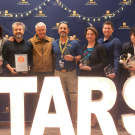
Several faculty members were honored at the inaugural Stars of SVM Staff and Faculty Award Reception in November. Each of the recipients exemplify excellence in supporting the mission of the school—advancing the health of animals, people and the environment—through educational, research, clinical and public service programs.


Congratulations to this year’s winners!


Among the Academies: Tackling the World’s Challenges

Jonna Mazet arrived at UC Davis as an undergraduate curious about veterinary medicine in 1986, and is retiring four decades of groundbreaking campus initiatives later, having built a legacy of cross-discipline innovation on global health problem-solving, particularly regarding emerging infectious diseases and conservation challenges.

"I am always motivated by the excellence, innovation and the collaborative spirit at UC Davis," she said.

Federal Funding Protects California’s Future

When Tommy Ma and Tiffany Pan adopted a 3-month-old Ragdoll kitten named Lychee in 2022, they expected joy, not heartbreak.

“Lychee was a dream come true,” Pan said. “Growing up, I’d never been allowed to have any large pets. Even cats are considered a large pet in my family.”

Just weeks after coming home, Lychee fell gravely ill. He began showing signs of feline infectious peritonitis, or FIP, a disease that was once fatal for cats.


Dr. Nicola Pusterla Wins National Equine Research Award


Dr. Nicola Pusterla, professor of equine medicine and dentistry, was awarded the 2025 Advancement in Equine Research Award presented by Boehringer Ingelheim, a biopharmaceutical company active in both human and animal health. The award was given during the 71st annual American Association of Equine Practitioners Convention held last week in Denver. Recipients of the award are chosen based on their research proposals which focused on this year’s subject matter of equine infectious disease.