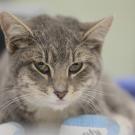
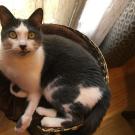
There’s always an implicit comparison when we talk about cats as aloof little jerks, says Mikel Maria Delgado, a postdoctoral researcher on cat behavior at the University of California at Davis. And that comparison is with dogs, which humans have spent thousands more years domesticating and molding in our image. Cats, she pointed out, simply don’t have the facial muscles to make the variety of expressions a dog (or human) can. So when we look at a cat staring at us impassively, it looks like a psychopath who cannot feel or show emotion. But that’s just its face.
Pet parent Laci Ping had just 15 minutes to pack up her life—which included six cats, six chickens, three dogs, and three reptiles—as the Camp Fire approached her home in Paradise, California. She managed to secure all but one of her animals – 5-month-old Mayson, a male gray tabby cat. Scared of what was happening, Mayson escaped at the last minute. Ping tried frantically to catch him, but he ran away too quickly. Heartbroken, Ping was forced to leave without him.
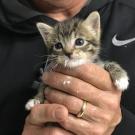
Every year, hundreds of thousands of kittens end up in animal shelters, in need of permanent homes. But raising orphaned newborns into healthy, fluffy, frisky 2-month-olds ready to be adopted requires an enormous behind-the-scenes effort.
Miao Miao, a 4-year-old male domestic shorthair cat, was brought to the UC Davis veterinary hospital with persistent nosebleeds. Based on previous medical issues, his owners were aware that he had some variation of a blood platelet disorder (causing an inability to properly clot blood), but the exact make-up of that was never discovered.
Researchers at the University of California, Davis Veterinary Medical Teaching Hospital recently performed a study to determine if intensive medical management offered a viable treatment alternative to surgery for feline patients with severe deep ulcerative keratitis.
Pet owners have lower blood pressure and less stress, and they exercise more, among other benefits. But pets can sometimes also pass on diseases. People magazine highlights how taking good care of your pet will help prevent the spread.
Maddie’s Fund, a national nonprofit that supports the status and well-being of companion animals, is granting more than $2.5 million to support the Million Cat Challenge as it expands to into its next phase of animal lifesaving in shelters across North America.
The latest newsletter from the UC Davis Clinical and Translational Science Center highlights collaborations among researchers from human and veterinary medicine. Articles include how clinical trials with animal patients speeds translation to improved care for people, partnerships in human-animal eye research, and new hope from novel canine cancer therapy treatments and feline stem cell therapy for an oral inflammatory disease. Read more
A rescued domestic shorthaired cat named “Lily” has helped prove the efficacy of a game-changing treatment for feline chronic gingivostomatitis (FCGS), or stomatitis for short. The lucky feline, adopted by Cyndi Luke of Davis, California, had been treated unsuccessfully for three years when she was recruited to take part in a stem-cell therapy trial testing a cutting-edge procedure for the painful oral condition.
Feline upper respiratory infection in shelter cats can be dramatically decreased by doubling cage sizes and providing cats with two compartments, reported Morris Animal Foundation-funded researchers at the University of California, Davis.