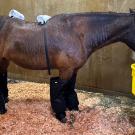
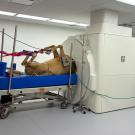
Standing equine positron emission tomography (PET) imaging is not just for racehorses anymore. In the first four months since the installation of the MILEPET scanner at the UC Davis veterinary hospital, 100 horses have been imaged; more than half were performance and pleasure horses.
The UC Davis standing equine positron emission tomography (PET) scanner is officially in use at Golden Gate Fields racetrack in Berkeley, CA, providing imaging at the molecular level to monitor racehorse health and guide training and medical care.
On April 14, 2021, local television morning show "Good Day Sacramento" visited the UC Davis Center for Equine Health. Dr. Mathieu Spriet showcased the latest in equine PET scanning technology.
On April 6, 2021, equine specialists from the UC Davis School of Veterinary Medicine's Center for Equine Health, Veterinary Medical Teaching Hospital, and the California Animal Health and Food Safety Laboratory joined with the California Department of Food and Agriculture to present “Update on Equine Herpesvirus Myeloencephalopathy for Horse Owners.”
Bella, a 20-year-old miniature donkey jenny, was brought to the UC Davis veterinary hospital for severe lameness and abnormally shaped hooves on all four feet.
On March 26, 2021, equine specialists from the UC Davis School of Veterinary Medicine's Center for Equine Health, Veterinary Medical Teaching Hospital, and the California Animal Health and Food Safety Laboratory joined with the California Department of Food and Agriculture to present “Update on Equine Herpes Myeloencephalopathy for Equine Practitioners.”
When Bella, a 7-year-old Thoroughbred maiden mare, went into labor last month, her owners Tom and Nicole Bachman were excited and sprang into action. But they soon realized something was terribly wrong.
One year ago, on December 12, 2019, Santa Anita Park installed the world’s first MILE-PET device, a positron emission tomography (PET) scanner specifically designed to image standing racehorses. This installation, one of several measures to reduce breakdowns at the racetrack, received a lot of attention at a time when Santa Anita was just coming out of a challenging racing season, with a cluster of horse fatalities early in the year.
Average stay in the hospital for the more than 50,000 animals that UC Davis treats every year is less than a week. It is a rare occurrence for an animal to be hospitalized for four months, but two alpacas that the UC Davis veterinary hospital’s Large Animal Clinic treated this fall did just that. Apple Jack and Jasper became household names at the hospital, being seen by nearly every fourth-year veterinary student who had a large animal rotation. The students and technicians even decorated their barn stall for the holidays.