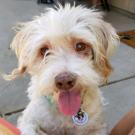
After a stick penetrated her eye, Eme was rushed to the UC Davis veterinary hospital where she underwent successful surgery with the Ophthalmology Service.
Thanks to UC Davis equine specialists in surgery and ophthalmology, Camino Del Paraiso is back to his winning ways after what could have been a career-ending injury.
When Teddy, a 12-year-old border terrier, was diagnosed with diabetes, his care team at the UC Davis veterinary hospital predicted he would eventually go blind. Within five months of the diagnosis, that prediction came true. Cataracts caused by the diabetes had formed in both of Teddy’s eyes completely clouding his vision. But UC Davis veterinary ophthalmologists offered hope, having performed many vision-restoring cataract surgeries over the years.
Bobby, a 12-year-old male miniature Schnauzer, developed cataracts in both eyes, presumably brought on by his diabetes. While he could still sense light in his eyes, the cataracts clouded his vision to the point of essential blindness. Navigation of his home was accomplished by memory and by utilizing a heightened sense of feel, especially on the staircase.
It’s fitting that Dr. Sara Thomasy is an ophthalmologist. Her eyes light up when she talks about the breakthroughs being made at UC Davis thanks to recent acquisitions of state-of-the-art imaging equipment. Eight new pieces of imaging equipment and one new piece of laboratory technology, made possible by grants from the Center for Companion Animal Health, now allow the Ophthalmology Service to provide new levels of care.
Rally, a 1-year-old female Labrador retriever, was accidentally shot while on a hunting excursion, with both of her eyes sustaining major trauma. She was referred her to the Ophthalmology Service at the UC Davis veterinary hospital who helped save her vision.
Hundreds of new genes linked to blindness and other vision disorders have been identified in a screen of mouse strains. Many of these genes are likely important in human eye vision and the results could help identify new causes of hereditary blindness in patients. The work is published Dec. 21 in Nature Communications Biology. The research team was led by Dr. Bret Moore, resident at the UC Davis Veterinary Medical Teaching Hospital.
Researchers at the University of California, Davis Veterinary Medical Teaching Hospital recently performed a study to determine if intensive medical management offered a viable treatment alternative to surgery for feline patients with severe deep ulcerative keratitis.
K-9 Officer Blitz, a 5-year-old German shepherd/Belgian Malinois mix with the Sanger Police Department, was performing routine training exercises with his handler and partner Corporal Brandon Coles when tragedy struck. While retrieving an item from under a car, Blitz caught his eye socket on the tailpipe, causing extensive damage. As Blitz bled profusely from around his right eye, Coles rushed him to a local veterinary clinic.