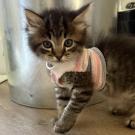
Dinx, a 10-year-old female cat, was brought to the UC Davis veterinary hospital for evaluation of a low grade soft tissue sarcoma mass on her ear that grew back after surgical removal a year prior. Most likely, another surgery would be required to remove the mass.
This statement is in response to discussions that have arisen due to inaccurate IMM/MYH1 genetic test results by a non-UC Davis affiliated laboratory. UC Davis is issuing this statement because of its relationship to research related to this test, because it has its own patent-pending IMM genetic test, and because the UC Davis Veterinary Genetics Laboratory offers the test as a service.
Design faculty in the College of Engineering (COE) are soliciting project ideas that originate in an unmet need within the field of veterinary medicine. Proposals can be related to solving a clinical problem, improving patient care, or to support a clinical research program, through the development of technology, a device or system process. Since 2005, undergraduate COE students have been collaborating with clinicians and researchers in the School of Veterinary Medicine to complete their Capstone Senior Design projects.
When Dr. Sabrina Wu was a baby, one of her first words was ‘cat’—which is a little weird because she didn’t have any pets growing up in Southern California. But that didn’t stop her fascination with all things related to animals.
Staff members of the UC Davis veterinary hospital were recently recognized for their dedication to providing the best customer service and contribution to clinical care. Five awards were handed out during the annual hospital staff awards presentation.
Congrats to Cara Newberry, Class of 2022, for being among 10 students nationally to receive an inaugural veterinary fellowship from the Foundation for Food and Agricultural Research (FFAR) and AAVMC.
UC Davis veterinary cardiologist Dr. Joshua Stern led a team of researchers that has found a link between some popular grain-free, legume-rich dog diets and a type of nutritional deficiency and canine heart disease known as taurine-deficient dilated cardiomyopathy. The FDA took notice and issued warnings about the potential connection.
Rhyme, a 2-year-old male ragdoll mix cat, was being medically managed for a liver shunt for the past six months. That followed nearly two years of trying to discover the root of his illness, which seemed to have plagued him for as long as could be remembered. When a specialist in Rhyme’s hometown of Vancouver, British Columbia finally diagnosed the shunt, he recommended Dr. Bill Culp at the UC Davis veterinary hospital, who has been performing a minimally invasive procedure to correct shunts in dogs for many years. Luckily for Rhyme, Dr. Culp has also utilized this technique in cats when presented with a similar scenario.
Oso, a 2-year-old chocolate Labrador retriever, started dragging his back legs while on a walk. His veterinarian in Bend, Oregon—surgeon Dr. Mauricio Dujowich, a UC Davis alum—performed an MRI that revealed a massive tumor inside his spinal cord, pinching the nerves to his back legs.
As one of only 215 board-certified zoological veterinarians in the world, Dr. Jenessa Gjeltema is rarer than some of the endangered animals she treats at the Sacramento Zoo.
8-year-old female spayed domestic short hair cat. Historical diaphragmatic hernia incidentally diagnosed three years ago. The patient has been intermittently coughing for the past few years. The past month, the coughing is more frequent / severe, with respiratory distress.
Four residents from the UC Davis veterinary hospital recently took home research awards from the 2019 American College of Veterinary Internal Medicine (ACVIM) annual conference. As one of the largest veterinary conferences in the world, ACVIM receives resident research submissions from some of the best and brightest young minds in veterinary medicine.
As Californians have fled ferocious wildfires in recent years, UC Davis scientists, veterinarians, physicians and teachers have also been responding to that trauma: treating people and animals, investigating the effects on mental and physical health, and trying to discover what the future might hold as wildfires burn into towns and suburbs.