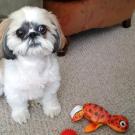
Jack the Shih Tzu was 7 years old when he traveled from Ontario, Canada to the UC Davis veterinary hospital in 2015. Given a cancer diagnosis with only a few months to live and with limited immediate treatment options, Jack’s family started a frantic search for help elsewhere. The search was a quick one, though, as one of the first items that appeared in their online hunt was a first-of-its-kind clinical trial at UC Davis to treat his exact condition.
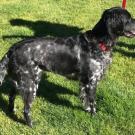
Max, a 4-year-old male Large Munsterlander, enjoys walks with his owners, Dr. Stevan Cavalier—a retired physician—and his wife Stephany near their home in the Bay Area. While they take precautions for their dogs due to the presence of foxtails in the area, it’s not always a guarantee that the dogs will stay completely away from the dangerous plants. Recently, Max had a decreased appetite, was lethargic, and had a fever and an increased respiratory rate. He was immediately taken to a local veterinary clinic.
Surgery resident Dr. Maureen Griffin was recently awarded the 2020 American Association of Veterinary Clinicians (AAVC) Resident Achievement Award. The recognition is given annually to a resident in their final year of training who has achieved a high degree of excellence in their chosen specialty.
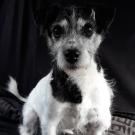
Whoudini, a 14-year-old male Jack Russell terrier, has lived quite the life. With his owner Maia Bailey since he was 4 weeks old, the little escape artist was aptly named because he constantly found a way to separate himself from the rest of the litter. “Even though he was the runt, he was strong and fiercely independent,” said Bailey. “It was love at first sight, and we’ve been inseparable ever since.”
Dakota, a 9-year-old male German shepherd, was diagnosed with a mass on his kidney and was taken to see the oncology specialists at the UC Davis veterinary hospital.
Charlie, a 2-year-old male Maltese mix, and his owner, Tyler Wilcox, were on a routine walk in their neighborhood when Charlie was severely attacked by a much larger dog. The other dog had Charlie is his mouth—shaking him violently—and was not letting go. Wilcox was forced to intervene, having to get physical with the other dog in order to save Charlie. Charlie was rushed to the nearest veterinary clinic where he was sedated and stabilized, but it was clear that his injuries were life threatening – he would need surgery within a few hours.
Rhyme, a 2-year-old male ragdoll mix cat, was being medically managed for a liver shunt for the past six months. That followed nearly two years of trying to discover the root of his illness, which seemed to have plagued him for as long as could be remembered. When a specialist in Rhyme’s hometown of Vancouver, British Columbia finally diagnosed the shunt, he recommended Dr. Bill Culp at the UC Davis veterinary hospital, who has been performing a minimally invasive procedure to correct shunts in dogs for many years. Luckily for Rhyme, Dr. Culp has also utilized this technique in cats when presented with a similar scenario.
Crash, a 6-year-old male German shepherd, was starting to tire more easily on his walks and seemed “spacey” and listless. An MRI revealed an intracranial arteriovenous malformation (AVM)-more commonly seen in humans-located within the brain and behind his eyes. Veterinary neurosurgeons collaborated with human specialists to treat his condition.
Makana, a 7-year-old female yellow Labrador retriever, was diagnosed with bilateral adrenal tumors so her owners brought her to the UC Davis veterinary hospital. Working together with the Internal Medicine Service, who were managing Makana’s case, surgeons with the Soft Tissue Surgery Service developed a plan to address her complicated condition. Surgeons at UC Davis are pioneering laparoscopic procedures for small animals, and have extensive experience in dealing with adrenal tumors.
Flynn, a yellow Labrador, and his family member Mason, a 16-year-old autistic boy, have formed a bond for the ages. When Flynn recently became ill, Mason vowed to do anything to help him. A community stepped in to make sure Flynn go the best care possible.