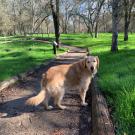
Starlit Sky, 7-year-old female golden retriever, has not had it easy over the past three years since an initial injury to her front left carpus (wrist). Suspected of slipping on a tile floor, she hyperextended the carpal joint which caused her paw to collapse under her leg. The injury was so severe that one veterinarian suggested amputation. Several failed surgeries and a similar injury to her right leg for overcompensation left Starlit Sky in a constant state of pain – wearing braces and enduring rigorous rehabilitation activities, none of which seemed to ultimately solve the problems. Determined to not have this be her fate in life, Starlit Sky’s owner Patricia Chiara took their physical therapist’s advice and brought her to the UC Davis veterinary hospital for an evaluation.
Thanks to a university-wide collaboration between veterinarians, physicians, researchers, and biomedical engineers, a groundbreaking clinical trial has been approved in human medicine to treat spina bifida with stem cells.
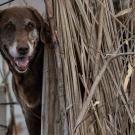
As a bird dog, Josie is one of the best. The 9-year-old chocolate lab goes everywhere with her owner and is a popular guest at the Cordelia Duck Club, tucked away in the Suisun Marsh. She is very social, extremely good at her sport and would really be missed if she weren’t around.
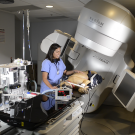
When it comes to dog years, cancer can have a big impact. Dogs 10 years and older have a 50% chance of dying from cancer, and human oncologists are studying the disease in canines in the hopes of benefiting both animals and humans.
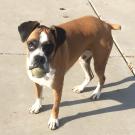
Porsche, a 4-year-old female boxer, had a lipoma surgically removed from her hip and lower back in 2019. But when it came back even worse in 2020, her primary veterinarian referred her to the Oncology Service at the UC Davis veterinary hospital. So, her owners Chuck and Jennifer drove the 90 minutes to campus for a consult with the oncologists.
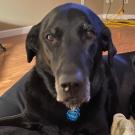
The 2020 LNU Lightning Complex Fire in Northern California devastated many lives. None more so than the owners of Quinn, a 12-year-old female Labrador retriever. Just before the fire erupted, Quinn was not feeling herself and was twice taken to her primary veterinarian. After many tests, she came home on the night of August 18. That would be the last time she would be in that home.
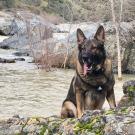
Life for Miro, a 5-year-old German shepherd, has been what his owner describes as an “emotional roller coaster” over the past two years. Several peaks and valleys have dotted his metaphorical landscape as he has gone from premiere fitness to dealing with injuries and disease. But a clinical trial at the UC Davis veterinary hospital may have put him back on a positive track.
The UC Davis School of Veterinary Medicine recently received an additional $75,000 grant from the Petco Foundation to continue its support of pet cancer treatments at the school’s veterinary hospital.
Scruffles, a 9-year-old female Shetland sheepdog, was referred to the UC Davis veterinary hospital after her white blood cell count continued to increase. The Oncology Service performed complete blood count tests to gain a better understanding of Scruffles’ condition, as well as a test called flow cytometry, which helped determine if Scruffles was dealing with a cancer of her bone marrow (leukemia).
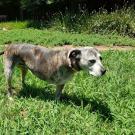
Kita, a 10-year-old female American Staffordshire terrier, began limping on her front right leg in November 2019. Shortly thereafter, she refused to walk at all. Her primary veterinarian diagnosed her with osteosarcoma in the leg. Her owners chose to have the leg amputated. Following amputation, Kita was referred to the UC Davis veterinary hospital for further recommendations on treating metastasis of the tumor.