The Winn Feline Foundation, a nonprofit that supports studies to improve cat health and has funded almost $6 million in health research for cats at more than 30 partner institutions worldwide, announced in April that it awarded more than $214,000 for 11 feline health studies.
Results of a five-year study in 20 countries on three continents indicate that bats harbor a large diversity of coronaviruses (CoV), the family of viruses that cause Severe Acute Respiratory Syndrome Coronavirus (SARS) and Middle East Respiratory Syndrome Coronavirus (MERS). Findings from the study—led by scientists in the USAID-funded PREDICT project at the University of California, Davis’ One Health Institute in the School of Veterinary Medicine and the Center for Infection and Immunity (CII) at Columbia University’s Mailman School of Public Health—are published in the journal Virus Evolution.
Friedreich’s ataxia patients have less mitochondria than other people because of the mutation in the frataxin gene that is associated with the disorder, according to two studies.
Despite the welcome rains in California this year, the fate of endangered Amargosa voles that depend on rare marshes in the Mojave Desert remains dire, with only about 500 animals remaining in the wild and most of their habitat degraded or dying.
Historically, pet owners have relied upon their veterinarians for pet medications, as well as their knowledge about appropriate dosages and adverse reactions for a wide range of species. However, a growing number of pet owners obtain prescriptions for their pets from community-based pharmacies, online retailers or compounding facilities.
The Arizona Daily Star asked veterinary experts from the University of California Davis School of Veterinary Medicine to weigh in on questions dog owners might have about the leptospirosis vaccine. Here are the answers from faculty member Jane Sykes and infectious disease fellow Julie Lemetayer.
With its internationally renowned school of veterinary medicine and its NCI-designated comprehensive cancer center, UC Davis is uniquely positioned to harness the power of each to tackle one of life’s greatest challenges: cancer.
In addition to serving as the teaching hospital for students of the #1 ranked veterinary school in the world, the UC Davis veterinary hospital also serves as a center for hundreds of veterinarians each year to receive advanced training. In the spring of 2017, Dr. Uchenna Nlebedum traveled 8,000 miles from his home in Nigeria to pursue a short-term internship with the hospital’s Ophthalmology Service, utilizing a scholarship from the International Society of Veterinary Ophthalmology (ISVO). Each year, the ISVO offers three distinguished scholars the opportunity to study for one month at any center of veterinary excellence in the world.
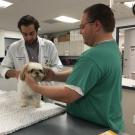
Cocoa, a 5-year-old male Shih Tzu, was diagnosed with high grade lymphoma in January 2017. He received a multi-drug chemotherapy treatment protocol until earlier this month.
Pickles, a 5-month-old male potbellied pig, was brought to the UC Davis veterinary hospital after he started coughing up blood and vomiting. He was diagnosed with an acute hemothorax (blood in the thoracic cavity) causing severe anemia and was extremely unstable. Treatment for suspected rodenticide intoxication was initiated immediately by the Livestock Medicine and Surgery Service.
Gremlin's eyesight hasn't been great for a while. A year and a half ago, her family began noticing signs of cataracts on top of her already partial blindness.
With a growing number of patients in need of expert cardiology services in the San Diego community, the UC Veterinary Medical Center – San Diego (UCVMC-SD) has opened a second location in San Marcos. Led by board-certified cardiologists Tim Hodge and Joao Orvalho, UC Davis’ cardiology services in Southern California offer a wide array of medical and interventional cardiology procedures.
Performing a CT scan on a horse is a laborious process that takes a team of nearly a dozen technicians and veterinarians. It involves forklifts and cranes, and the skilled techniques of veterinary technicians who have mastered this task after years of repetition. Thanks to an innovative UC Davis imaging technician, however, that process just got a lot less complicated.
As UC Davis leads the way in clinical veterinary care, and envisions a new Veterinary Medical Center (VMC) on the horizon, expansion of existing examination space within the current hospital is already happening. Recently, construction began on the creation of new treatment rooms for exotics care, soon to be followed by several new examination rooms in the Small Animal Clinic (SAC). Divided into three phases, these smaller projects mark the beginning of the larger implementation of the VMC vision for the future of UC Davis veterinary medicine.