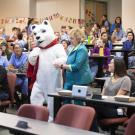
The school celebrated its inaugural Global Programs Day with a lunch seminar addressing climate change and an evening presentation by students who completed summer externships and fellowships around the world.
Researchers have good news for owners selling or managing horses with ostoechondral fragments (OCF) in the hock: A recent study has confirmed that arthroscopic osteochondral fragment removal in horses’ tarsocrural joints via arthroscopy is efficient, quick, and has few postoperative complications.
Thoroughbred racehorses who suffer catastrophic musculoskeletal injuries are more likely to show lameness in the three months leading up to their injury than horses that race without incident, research has shown.
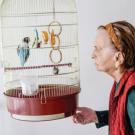
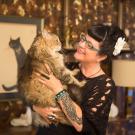
Veterinary teams can factor in the needs of the elderly and those with disabilities, as the need for care for pets belonging to older populations is only going to climb.
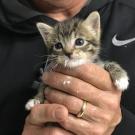
Every year, hundreds of thousands of kittens end up in animal shelters, in need of permanent homes. But raising orphaned newborns into healthy, fluffy, frisky 2-month-olds ready to be adopted requires an enormous behind-the-scenes effort.
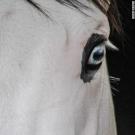
Southern Phantom’s face is entirely white, with mismatched blue and brown eyes. The short answer to why is his coat like that, there is likely a mutation in one or more of the genes involved in pigmentation.
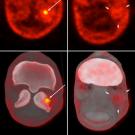
Positron emission tomography (PET) scanning technology has been proving its worth in assessing issues in the horse’s foot and the suspensory ligament.
The technology has been pioneered by UC Davis, which became the first veterinary hospital in the world to install an equine PET scanner in 2016. Since then, there have been more than 85 equine PET studies.
The National Oceanic and Atmospheric Administration has opened an investigation into hundreds of seal deaths this summer. Nearly 600 harbor and gray seals stranded on beaches from Maine down to Massachusetts.
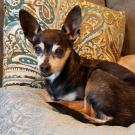
“We were devastated to learn our beloved Chihuahua Pixie, had leukemia," said Pixie's owner. "Things did not look good, but with the help of the doctors at the UC Davis veterinary hospital, we decided on chemotherapy treatment."
Surgical and medical treatment for sand accumulations in horses is likely to end well. Radiography is one of the only ways to objectively measure the condition.
For more than 50 years, Michael Muir (yes, the great-grandson of conservationist John Muir) has been breeding horses with the help of the UC Davis veterinary hospital’s Equine Field Service and Equine Reproduction Service. His unique breed of the Stonewall Sporthorse wins national and international competitions--as well as the hearts of those who find a new lease on life from the therapy they provide.
For the first time, scientists discovered a new ebolavirus species in a host prior to detection in an infected human or sick animal. This discovery Illustrates PREDICT project’s goal to find viruses before they spill over into people.